The problem
Western Australia has over 12,000 kilometres of coastline and more than 1600 recorded shipwrecks, including the Batavia, lost in 1629. When the Batavia was found, our state passed the first laws in the world to protect underwater heritage. That one wreck yielded 26,731 artefacts and 10,619 coins.
The manipulator arms bolted to remotely operated vehicles are built for industrial work, not precision handling. The standard arm has two rigid metal fingers, no force feedback and little surface contact, which makes it clumsy with small, irregular or brittle objects. Four failure modes came out of talking to working archaeologists and subsea engineers: high risk of breakage, poor grip on odd shapes, limited awareness for pilots, and cost and time pressure.
The cost asymmetry is what makes it worth solving. Boat hire runs around AUD 5,000 per day and a four person dive team another AUD 1,200 per day, on top of vessel charter, crew wages, shipping, port fees, insurance, fuel and permits. A two-thousand-dollar tool failure can waste a million-dollar mission.
All the wrecks we have found in Western Australia in the last four to five years are beyond recreational diving depths. The museum legally can't excavate them. The only way to recover something safely from 50 to 60 metres and beyond is a robot with actuator control.Patrick Morrison, Assistant Curator of Maritime Heritage, WA Shipwrecks Museum
One degree of freedom
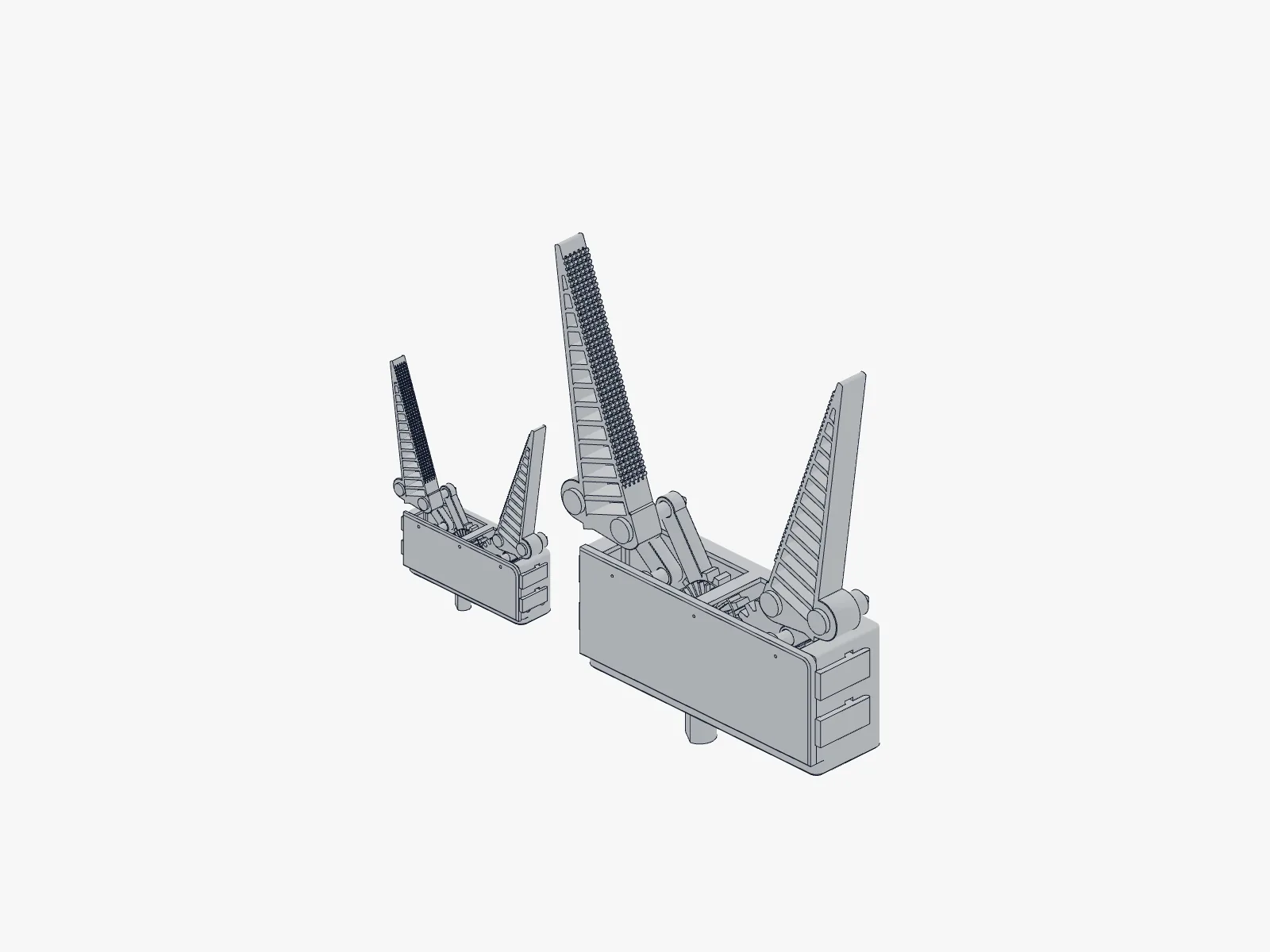
Rotate one input shaft and both fingers open and close symmetrically, splaying outward as they open to give a funnel-mouth catch. Everything else follows from that one rotation.
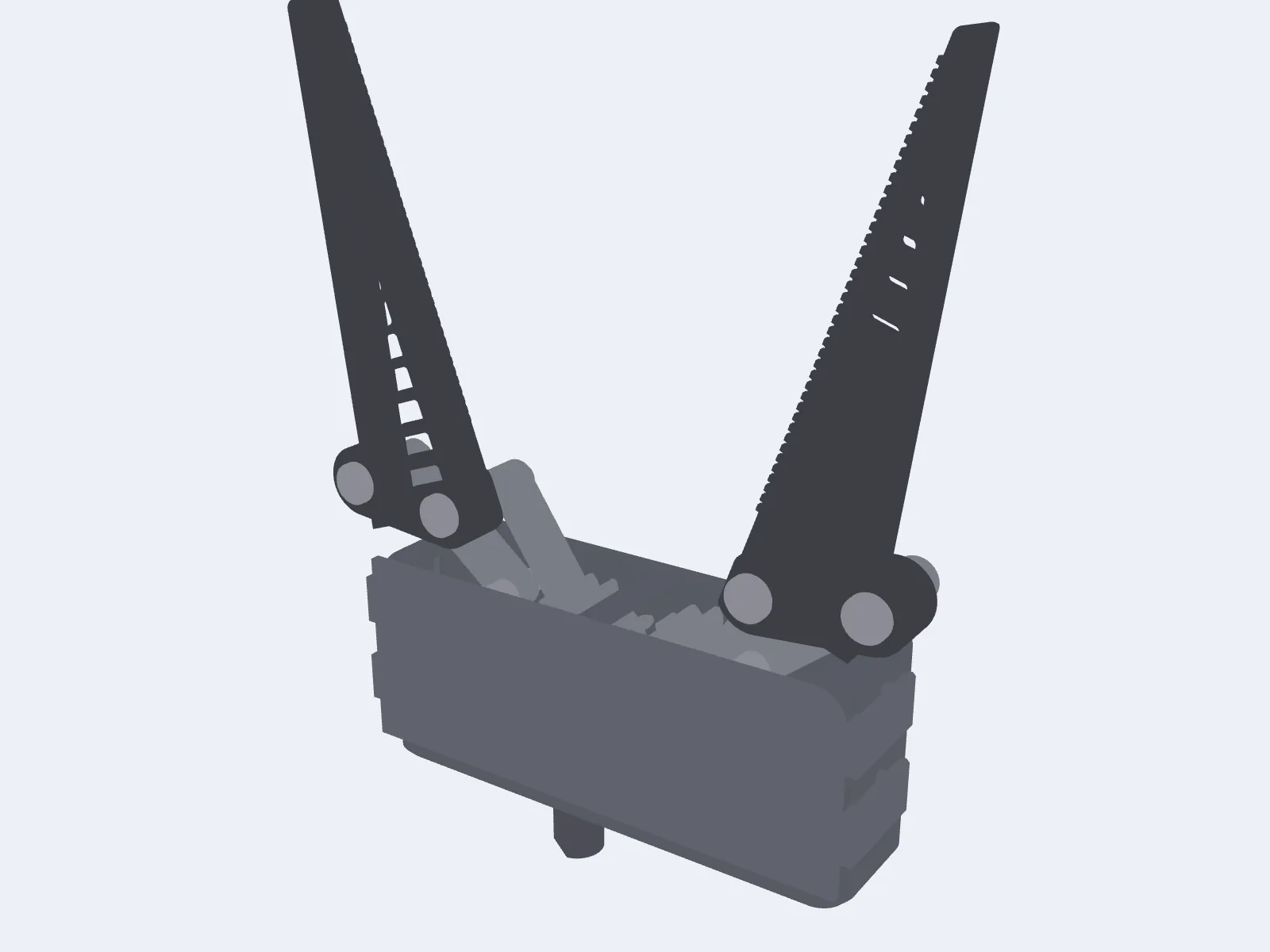
Two equal spur gears mesh on the centreline. The left gear is driven through a 90 degree straight bevel pair, a 12 tooth bevel gear fused to its top face driven by an integral 6 tooth bevel pinion on a vertical input shaft, so the drive enters the housing from the bottom while the fingers point up. The mesh counter-rotates the right gear, so one shaft moves both fingers as a mirror pair. The bevel teeth are deliberately coarse and thick, module 1.8 at 25 degrees pressure angle, sized by the gear strength analysis rather than by packaging.
Each gear is the crank of a non-parallelogram four-bar linkage, with the finger rigid with the coupler. The link lengths give a translate-apart motion plus roughly 18 degrees of outward splay across the travel, and they are sized so the transmission angle stays clear of any dead point. At full scale the jaws close to about 1.6 mm apart and open to about 60 mm at the base and 118 mm at the fingertips.
The bottom of the input shaft carries a female 25 tooth spline socket, so the bus servo presses straight in with no adapter horn.
The Fin Ray fingers
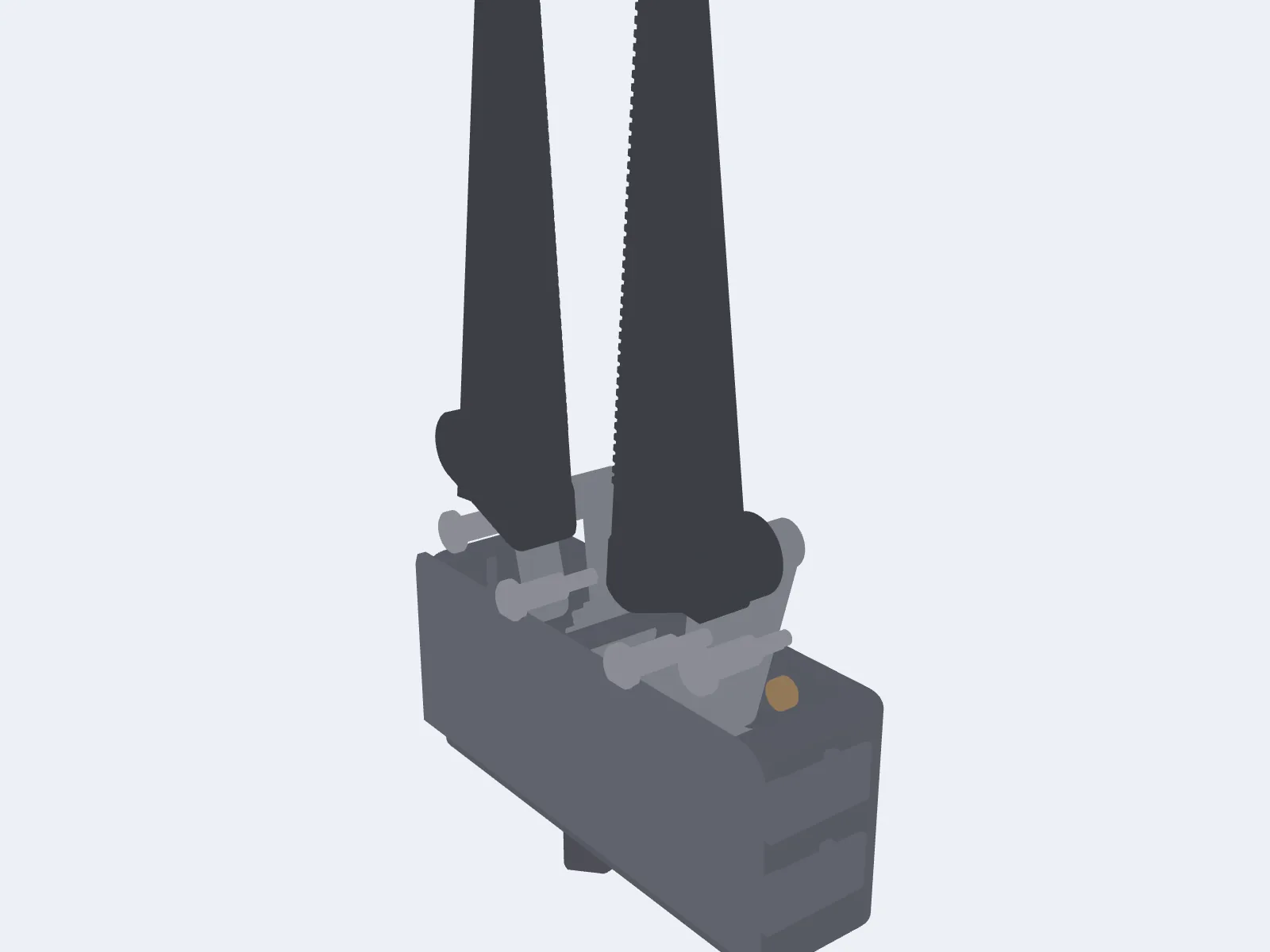
Each finger is a passive compliant triangular truss printed in TPU. When the contact face presses against an object, the internal ribs make the whole finger curl inward and wrap, so it conforms to whatever shape it meets instead of touching in one narrow band. There is no motor, tendon or moving part at the fingertip to seize underwater.
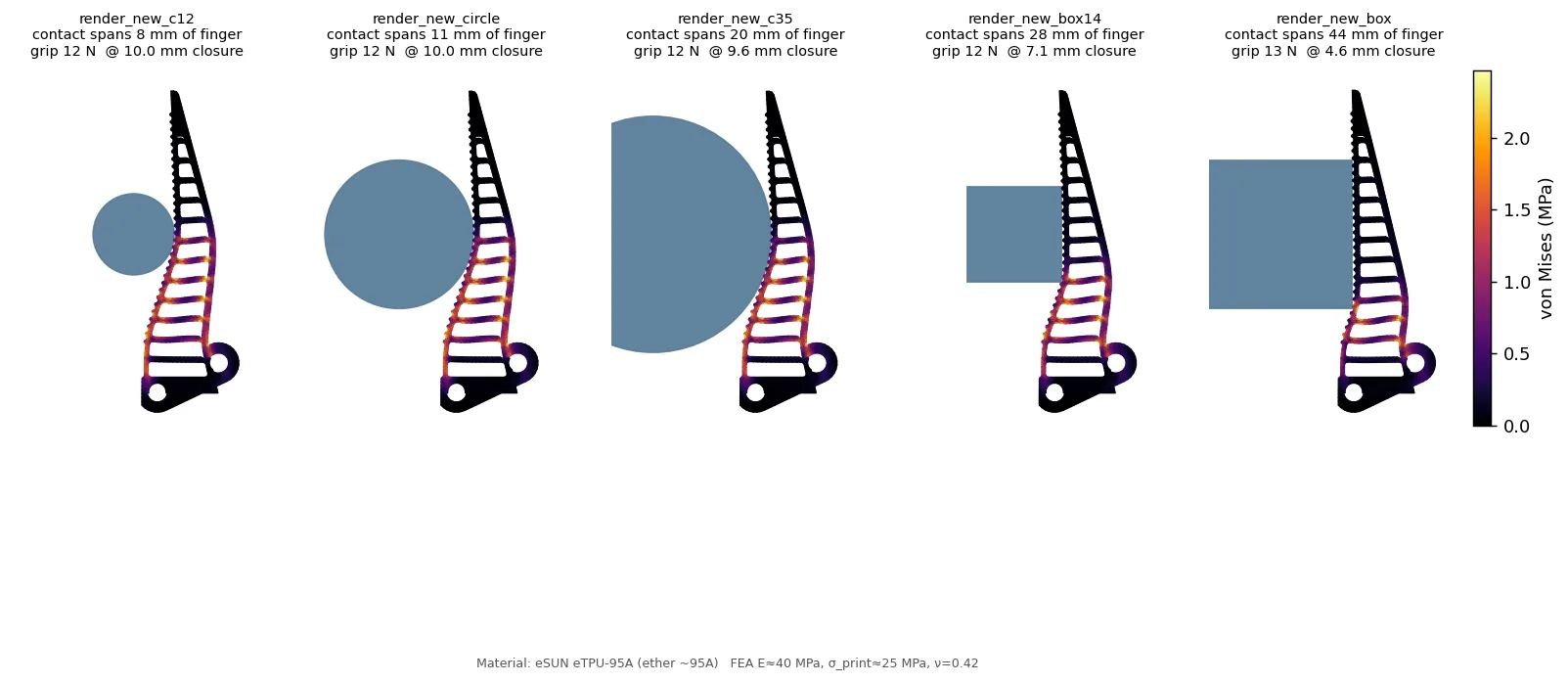
The shipped geometry is a 1.2 mm contact beam, a sharply tapered 1.8 mm spine, and 14 fine 1.6 mm ribs at 38 degrees with a reversed slant, tapering to a 2 mm tip. This is the generic adaptive-compliant slanted-rib truss principle, not the patented tooth-shape variant.
We built a physics model and ran a design search through it, scoring each candidate against a battery of seven object shapes and sizes, and committed to a geometry once it won in software.
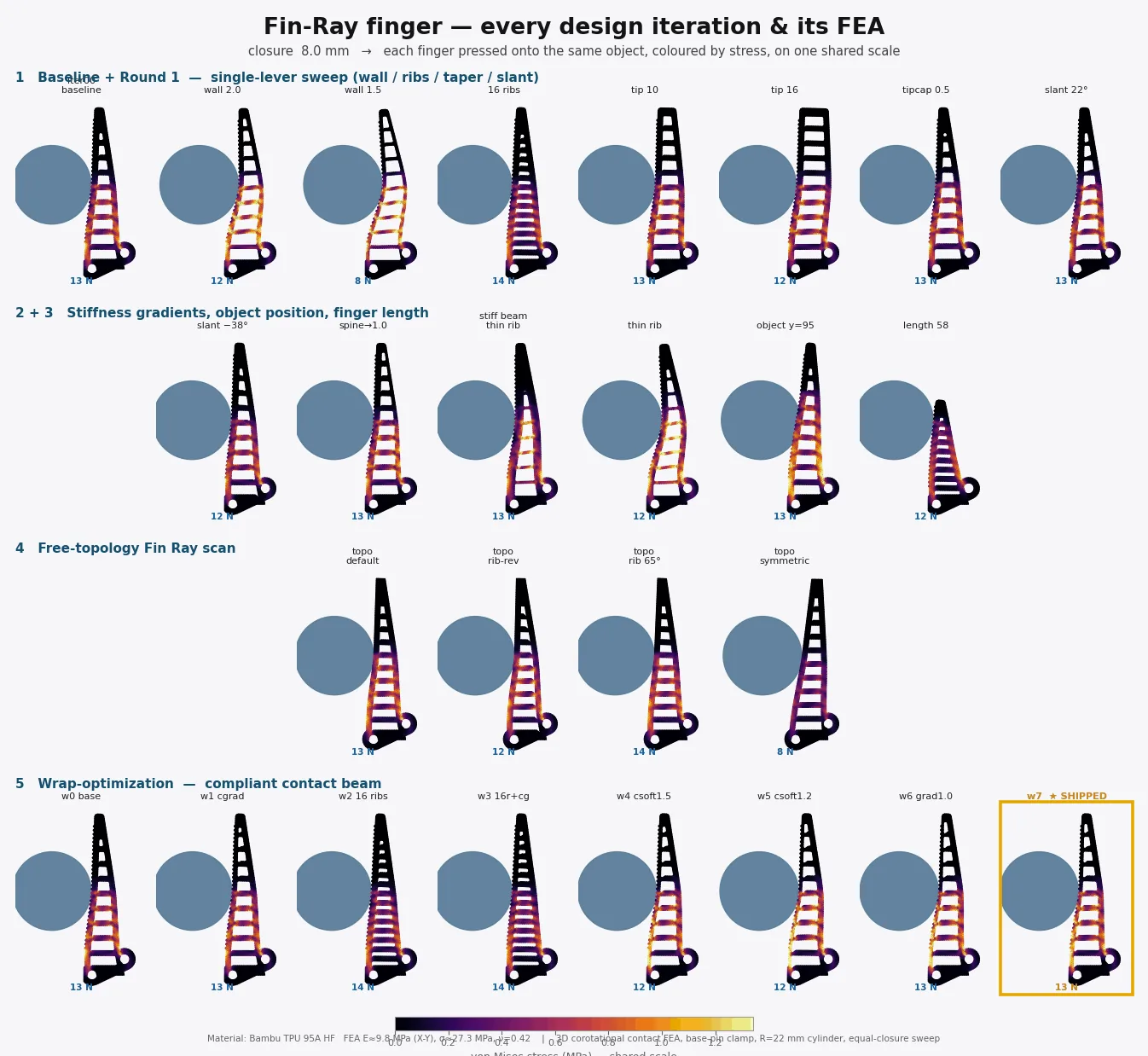
Two dead ends are worth recording. A concave contact face matched to the object went nowhere, because universality turned out to be a measurement gap rather than a shape problem. And the flexure family was ruled out with data: the contact-notch flexure gave the only real circle wrap in wave one, but its grip jumped chaotically between 0 N and over 100,000 N at adjacent 0.25 mm steps.
The grip texture
Finger geometry decides whether you wrap an object. Surface texture decides whether you hold onto it once wet. The structural analysis cannot answer that question, because it has no friction model and no fluid model, so the texture got its own campaign. TPU comes off the print bed with a glossy, low-friction skin, which is exactly the wrong surface for a wet artefact.
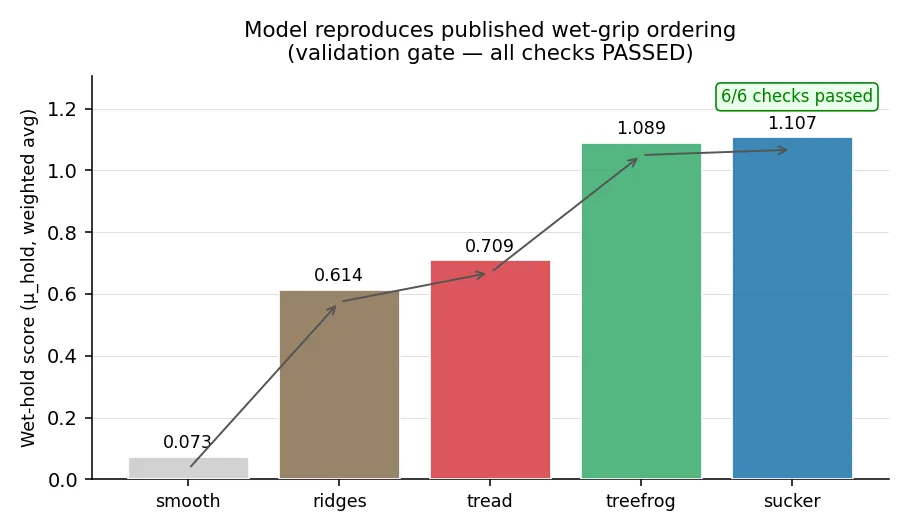
Before the model was allowed to rank anything, it had to reproduce the published wet-grip ordering of five real patterns. All six ordering checks pass, and the design sweep was gated on that passing.
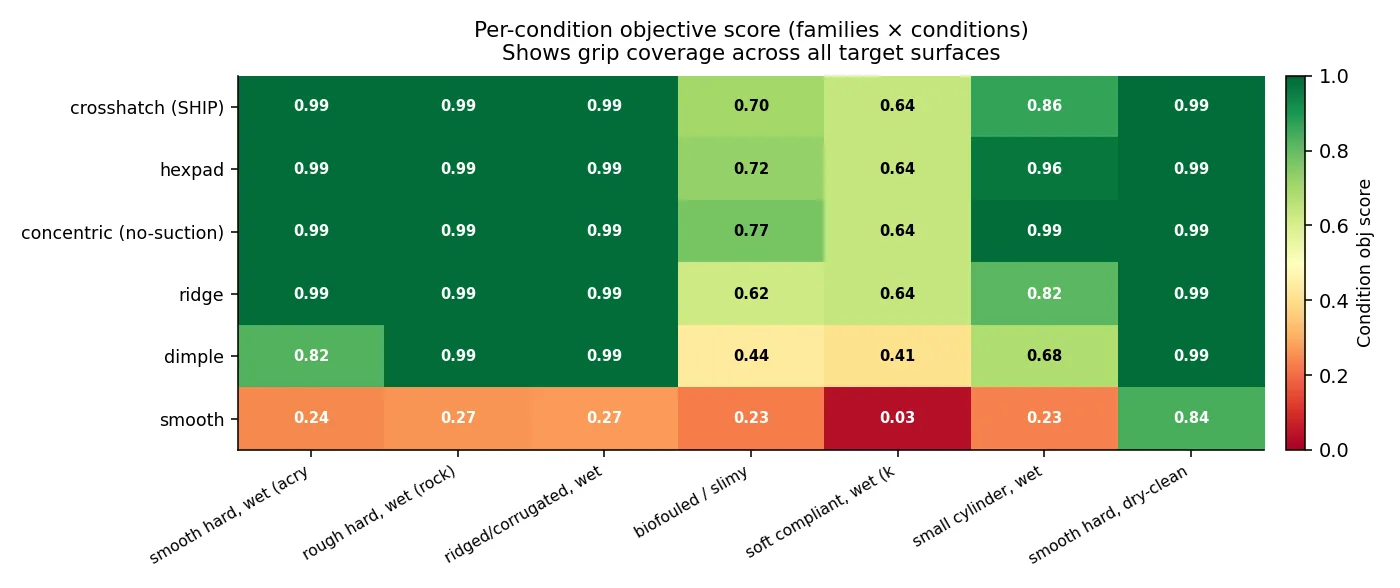
Seven texture families then ran in parallel, each sweeping its full parameter space at 0.1 mm resolution and refining around its best score: ridge, crosshatch, chevron, hexpad after tree frogs, concentric after octopus suckers, dimple and hierarchical. Together they produced more than 700,000 model evaluations.
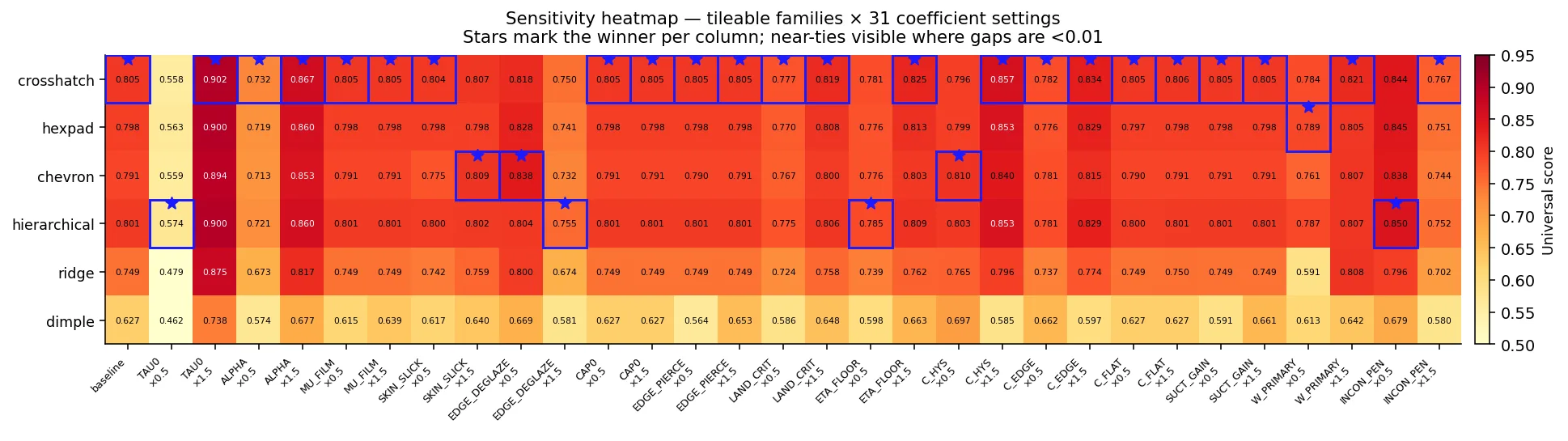
Concentric is the model's invariant winner and we did not ship it, on purpose and on the record. It cannot tile the blade: the contact face is about 72 by 10 mm, and at a 1.4 mm ring pitch at most one full rosette fits across the width. The model has no tileability term, so this is a missing-physics override applied externally. Its remaining lead also leans on a speculative micro-suction term that a printed TPU cavity cannot sustain, because the stepped layer rims break the seal.
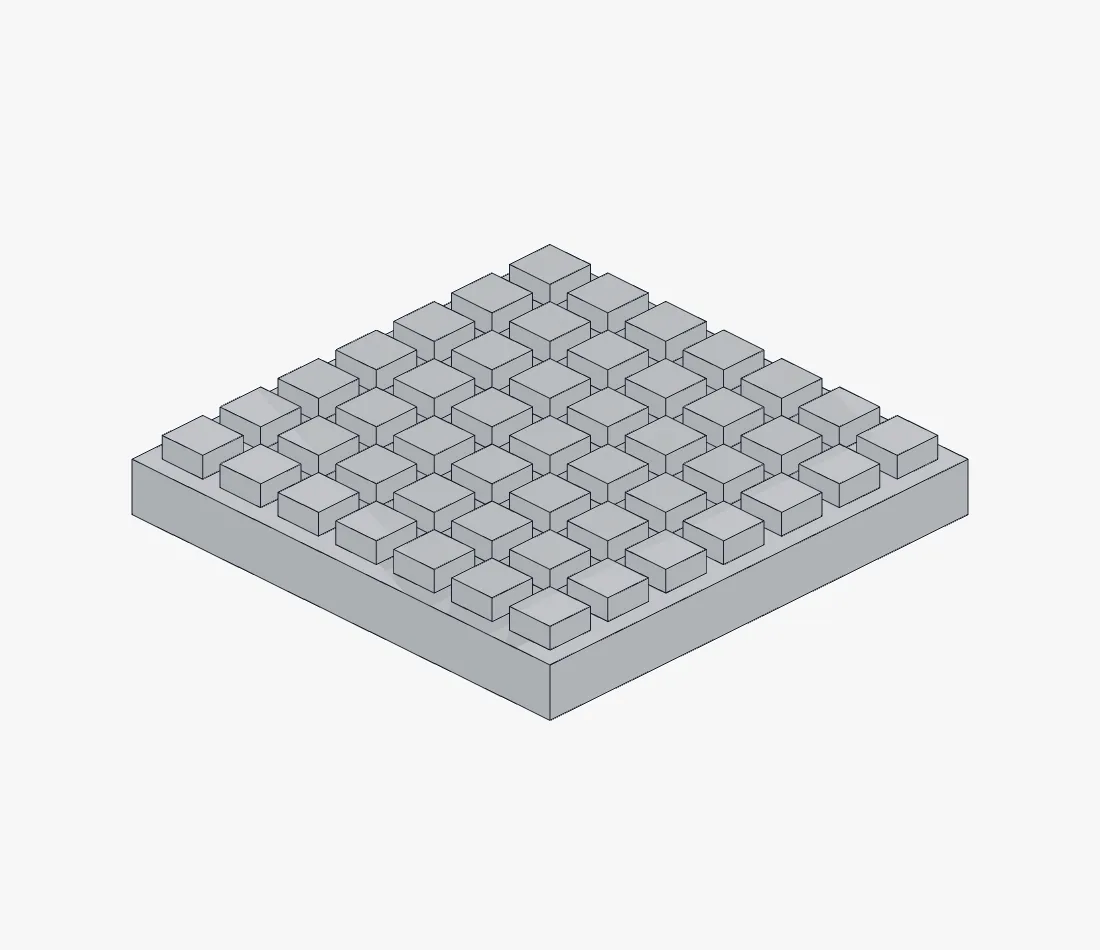
What ships is crosshatch: 1.8 mm posts with 0.54 mm crossing channels, 0.6 mm deep, with the channels sized above the drainage threshold so water is squeezed out of the contact patch rather than trapped under it.
Sensing force through the motor
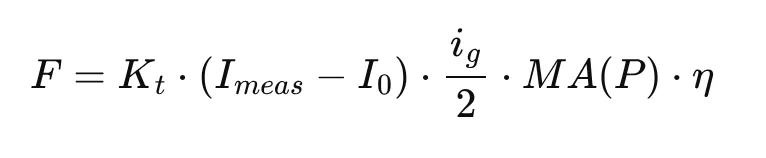
The project takes its name from this. No dedicated force sensor sits anywhere on the gripper. It reads the actuator's motor current, multiplies by the torque constant, and traces that back through the drivetrain to recover an estimated tip force. That is the same method force-controlled industrial and surgical grippers rely on.
That buys three things an underwater tool wants: no wires running through a flexing TPU finger, no fingertip connector to flood, and no separate analogue front end to seal.
If you have a force sensor in the motor, you've replaced one of the worst sealing problems with one of the easier ones.
The first design put a calibrated conductive-foam pressure sensor under each fingertip pad. Two reviewers, working independently, talked us out of it. David Howard at CSIRO pointed out that ambient water pressure rises about one atmosphere every ten metres, so a fingertip pressure sensor reads a squeeze that is not there and needs a second ambient sensor plus a software correction to recover the true value. Patrick Morrison pointed out that any foam or gas-filled pad compresses with depth as the air pockets inside it shrink, so a pad-based sensor drifts as the dive gets deeper. Current sidesteps both, because it tracks how hard the finger pushes the object rather than the water column above it.
Calibration is a dry bench job. A load cell at the contact face is the ground truth that turns the relative current signal into newtons: log current and force pairs at 8 to 12 force levels over three cycles each to capture hysteresis and drivetrain friction, regress a quadratic to absorb the motor nonlinearity, and validate on blind weights.
The controller is one small board that travels with the gripper: an ESP32 driver board that boots its own Wi-Fi access point, serves a captive web page with open and close controls and live position, load, voltage and temperature, and acts as the servo's bus master. No router, no internet, no topside computer. It also carries stop-on-load, a gentle stop on contact. It replaced an Orange Pi controller after that board died, and the Pi version is kept in the repository as a working alternative.
The flooded drive
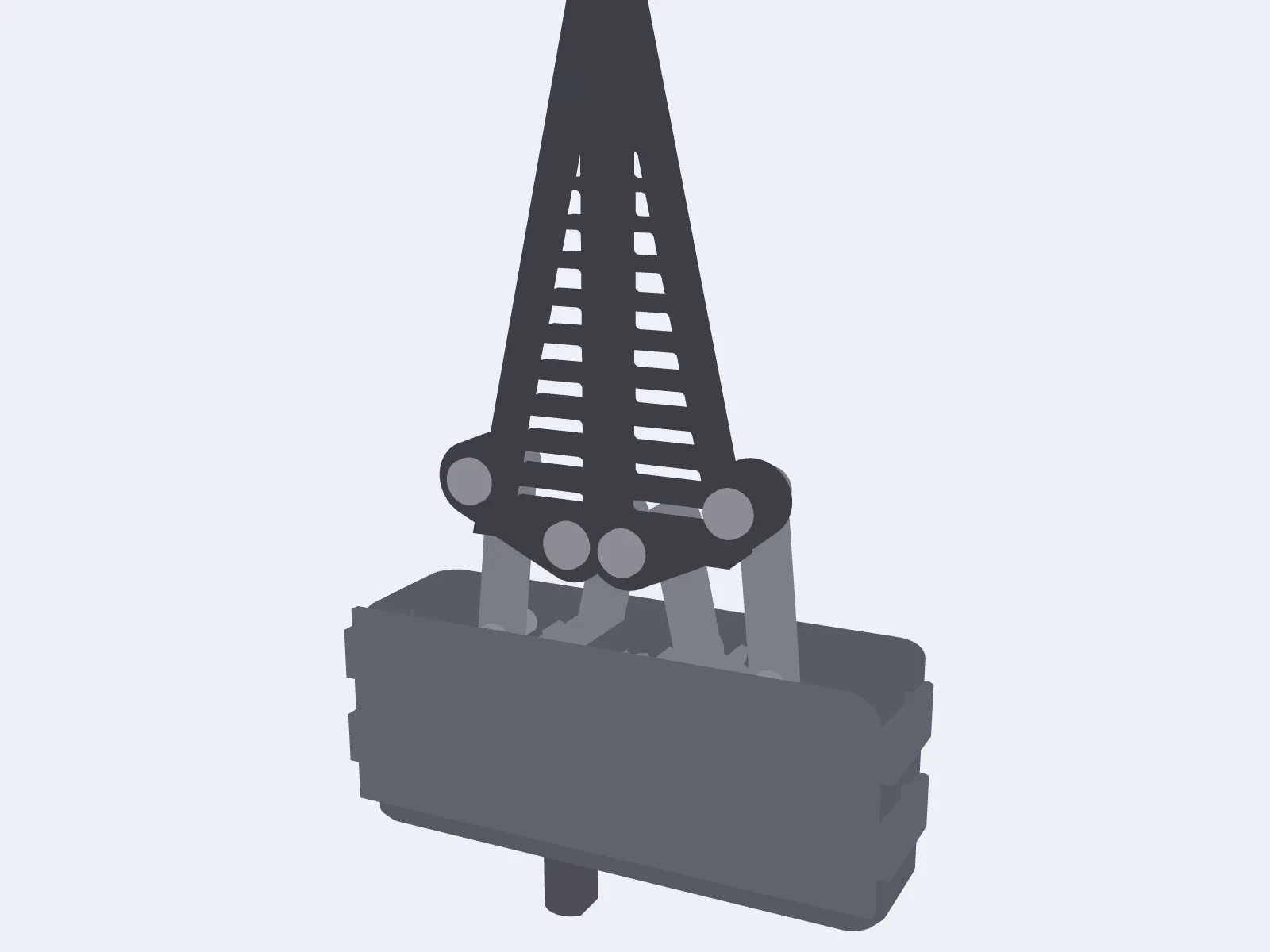
The enclosure is a rounded housing with an open front and a snap-on cover. Inside sit the gears, the four-bar links and the right-angle stage. The vertical input shaft exits through two journal bearings in the bottom wall, surrounded by a mounting flange with four M4 bolt holes.
It is designed to flood. Drain and flood holes let water in and out so there is no trapped air and pressure equalises with depth. Every part is a single solid with exactly one shell, and there is no enclosed void anywhere in the assembly. With no enclosed void, depth has nothing to crush.
The consequence is a procedure rather than a redesign. Submerge the gripper fingers down and let it soak so the flood paths clear.
Two constraints hold whatever else changes. The sealing job falls on the actuator, so even an IP68 rated servo still needs a thin pressure canister, because IP68 is rated for one metre of freshwater while 30 metres is 3.1 bar plus seawater corrosion. And the motor current limit must be set to the safe gear torque in firmware, because without it a strong servo's stall torque shears the printed teeth.
Materials and printing
There is no metal anywhere inside the gripper. Every pin, snap, gear and shaft is printed. The only metal in the system lives inside the user's actuator canister, isolated from the seawater. That takes galvanic pitting, bushing dryout and dowel galling off the table before they can start.
The build is 25 printed parts with zero purchased hardware and zero fasteners. The only tool needed is a soldering iron: each journal pin is retained by a cap melted over its stud into a thermal rivet head wider than the bore.
| Part group | Material | Why |
|---|---|---|
| Enclosure, cover, gears, links, input shaft | PA12-GF | The lowest water uptake engineering nylon available. Saturated seawater absorption around 0.7 to 1.2 per cent, lower again with the glass fill. It does not hydrolyse, and 30 per cent glass gives roughly 3.5 to 5.5 GPa modulus with low creep. |
| Fingers | TPU 95A HF | The Fin Ray principle is entirely material compliance. The fingers have to flex visibly as they wrap. Ether-based TPU is recommended for sustained immersion. |
| Pins and retaining caps | PETG-HF | Glass fill trades ductility for stiffness, and these parts have to flex and then melt into a rivet head. |
An earlier specification called for carbon-filled Nylon 12. It was dropped because it needs a 45 to 60 degree heated chamber that our printer cannot hold, and it still absorbs water. PA12-GF is marginal on the same printer too. Glass-filled nylon warps on the larger parts and wants a closed chamber, a brim, and a hot nozzle over a hot bed.
Test results
On the bench
The scaled prototype was tested against four artefact-analog objects picked for their range of shapes: a bone, an anchor, a vase and a treasure chest. The bone and the anchor are both long, but the anchor has natural grip features and the bone has none. The chest and the vase are both stout, but the chest has grooves and the vase is smooth with only the head to grab.
| Object | Attempts (4 fingers) | Attempts (2 fingers) | Pressure to grip |
|---|---|---|---|
| Bone | 2 | 4 | 26 gf |
| Anchor | 5 | 4 | 96 gf |
| Vase | 3 | 5 | 411 gf |
| Chest | 3 | 3 | 288 gf |
Four fingers beat two on smooth or round shapes such as the vase, and on shapes with poor grip features such as the bone, and tie on shapes with regular features. When an artefact has natural features for a rigid jaw to bite, three attempts is the ceiling. When it is smooth or featureless, the four-pad layout wraps it and the two-jaw layout slips off it.
The grip pressures span an order of magnitude, from 26 gf on the bone to 411 gf on the vase. That is the empirical case for per-artefact presets: a single global threshold would either crush the bone, if set high enough to lift the vase, or fail to lift the vase, if set low enough to spare the bone.
In simulation
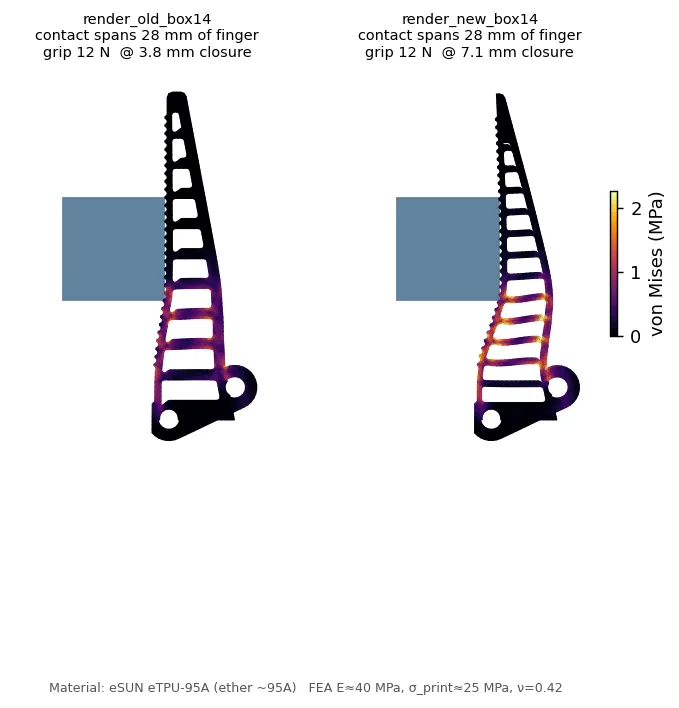
The shipped finger grips every object in the battery at a consistent test load, where the previous finger's grip swung by a factor of seven with object height. On round objects the contact arc roughly doubles, and the shipped finger wraps both square sizes where the old one only wrapped one.
| Object | Old finger contact arc | Shipped finger contact arc |
|---|---|---|
| Cylinder 24 mm | 2° | 2° |
| Cylinder 44 mm | 7° | 17° |
| Cylinder 70 mm | 11° | 21° |
| Square 28 mm | 1° | 87° |
| Square 44 mm | 88° | 87° |
On the wet-surface battery the shipped crosshatch scores 0.99 on smooth, rough, ridged and dry surfaces and 0.86 on a small cylinder, degrading only on slime at 0.70 and soft objects at 0.64. The smooth control fails on every wet surface, which is the hydroplaning the texture exists to defeat.
The binding limit
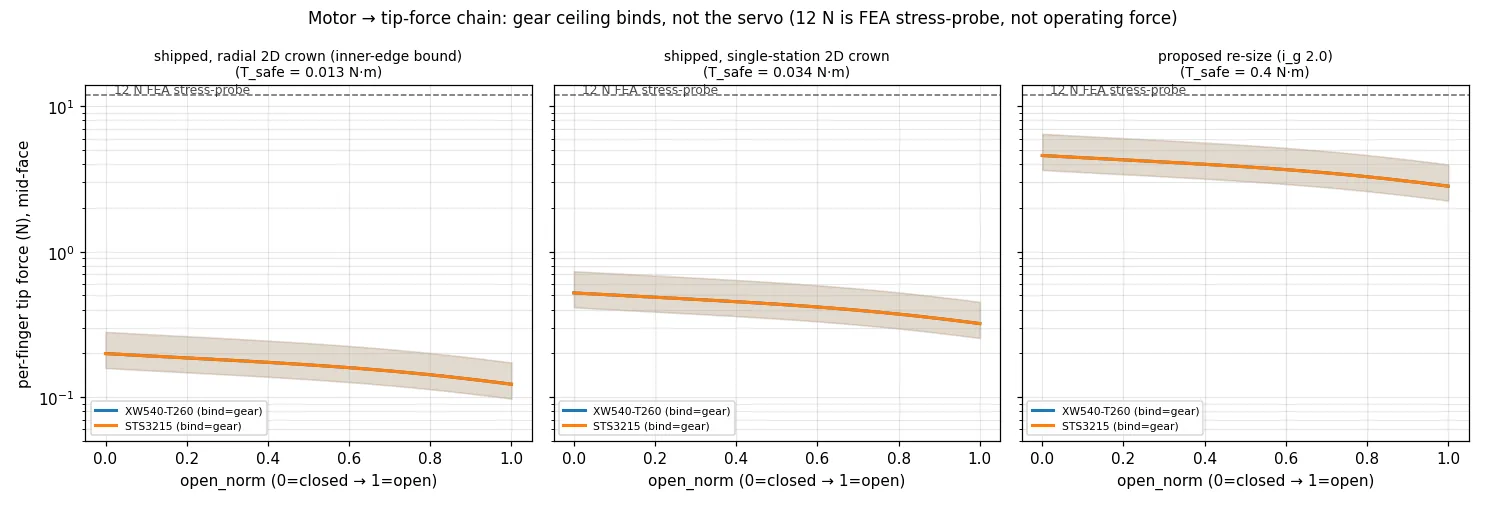
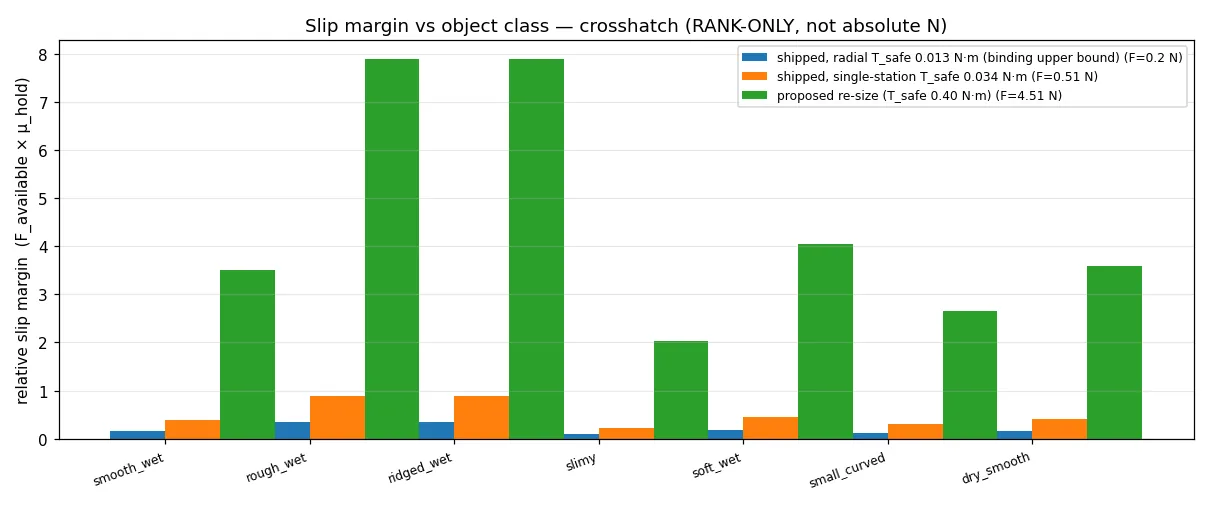
The compact right-angle stage sets the structural limit of the whole gripper, ahead of the servo. At the small radii the housing allows, printed teeth carry far less torque than the analysis probe load would need. The fix has three parts: strengthening the teeth, which is done and build-verified; a module and radius re-size, which is proposed and still needs clearance validation; and the motor current limit holding the safe ceiling in firmware.
Fitting it to an ROV
The gripper mounts through a common gripper-side mate, with adapters modelled for the Reach Robotics Bravo 7 wrist, ISO 9409-1 cobot flanges, the BlueROV2 bottom panel, roof rack and payload skid, and an ISO 13628 D-handle override for diver operation. The Bravo 7 is the Fugro and Woodside reference mount in Western Australia, which is why it is the integration target we designed against.
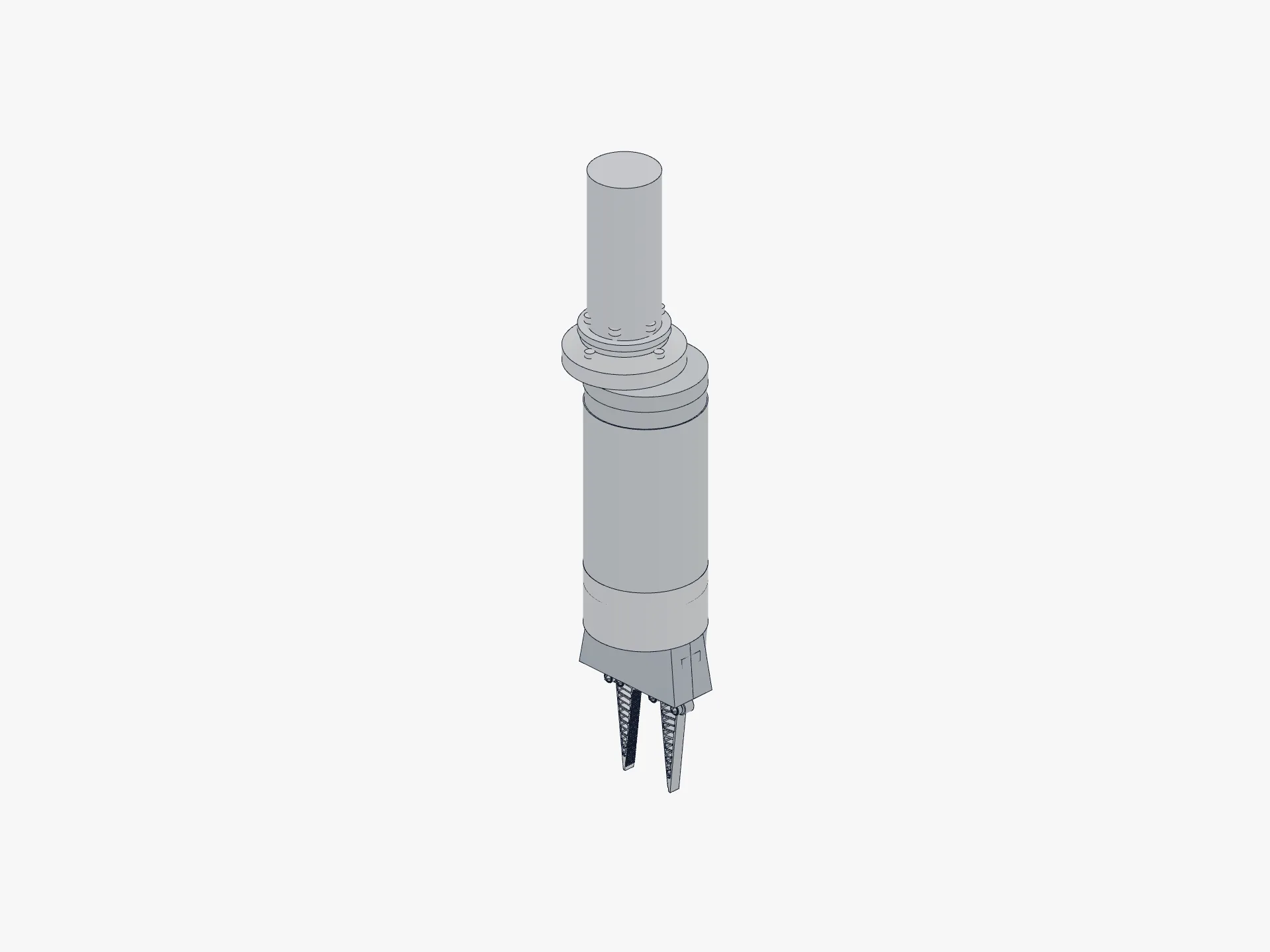
Scaling up is one parameter rather than a redesign. A single scale variable multiplies every linear dimension, and two larger sizes at 1.5 and 2.0 times were built and fully re-simulated from it. Because lengths, radii and wall thicknesses grow by the same factor, every ratio and angle is preserved. A few things are deliberately held constant: print and running clearances stay at about 0.3 mm because they are governed by the nozzle, fastener sizes stay put, and flood hole radii are sized by surface tension physics rather than by the part.
Operating boundaries for the production target: 0 to 50 m depth for the shipped configuration, minus 2 to plus 30 degrees water temperature, continuous immersion up to 30 days with a freshwater rinse between deployments, full marine to brackish salinity, and a 2 to 5 kg payload. Finger replacement is at 10,000 grip cycles or the first visible crack.
On the NASA technology readiness scale the project sits at TRL 3 to 4: a working scaled prototype with all four innovations integrated and bench-tested, with simulation validating the fingers and the texture. TRL 5 needs a pool dive on a real ROV chassis with an artefact analog at depth.
What the reviewers changed
The design's credibility rests on working engineers examining it and pushing back. Most of the major decisions trace directly to one of these conversations.
- Tim MacDonald, subsea engineer at Inkfish, formerly of the DSV Limiting Factor. Confirmed that soft-jaw and silicone-tipped grippers already exist, so force feedback on a cheap printed gripper is the new part. That reframed the whole project around sensing rather than softness. His economics argument is the source of the modular kit approach, and his materials steer set the constraint the whole material selection runs inside.
- Patrick Morrison, WA Shipwrecks Museum. Grounded the problem statement, supplied the mission cost case, and his engineering notes map onto the build one to one, from the depth drift on foam pads to the fail-gripping-not-releasing firmware rule and the accept-flooding architecture.
- David Howard, Principal Research Scientist at CSIRO. Identified the ambient pressure confounder that moved the force channel into the motor current.
- Fiona Stachowiak and the Woodside Energy subsea team. Their water absorption warning, from real bushing swell experience, triggered the material change. Their magnetic coupling reference became the fallback actuator, and their two explicit asks, a readiness self-assessment and stated operating boundaries, are why those exist in the form they do.
- Elaine Pankhurst, Fugro Australia. Confirmed that the pressure-feedback approach parallels Fugro's own ROV valve-control work, which is independent validation that the core idea holds at industrial scale.
- Damien Singh, Total Marine Technology. Put the documentation in front of TMT's CEO for engineering review, opening TMT's mentorship and backing.
The 2026 Korea Open
SoftSense was the innovation project Lebob took to the FIRST LEGO League Korea Open Invitational, held from 3 to 5 July 2026 at Jeonju National University of Education in Jeonju, South Korea. More than 50 teams from over 45 countries competed across the three days, with judging on the Saturday and Sunday morning and the awards ceremony on the Sunday afternoon. SoftSense won a prize. The project was closed out in July 2026 and the repository is the consolidated final record.
The judging material included an eight-person presentation skit dramatising the crush versus recover story, and the controller was built with wireless telemetry specifically so the judges could watch a live force readout while the gripper closed.
The full engineering documentation as submitted is published on this site, and the deck is available slide by slide.
What we are not claiming
The project has a standing rule that the honest framing gets published next to the headline. These are the caveats as they appear in the repository.
- The 12 N figure used throughout the finger analysis is a stress-probe load for ranking finger designs, not an operating force the drivetrain delivers. The printed right-angle stage caps input torque well below it.
- We computed the published safety margin with elements that lock volumetrically near the incompressible limit. The locking-stable re-run puts the corrected margin nearer 3.8 to 5.7 times at the probe load, and around 120 to 365 times at the force the drivetrain delivers. The design call does not change. We had the absolute number wrong and have corrected it.
- The grip texture model is rank-only. Its literature gate is a sufficient-condition check, and the shipped pattern won only after a documented override of the model's raw winner.
- The safe gear torque is a 2D upper bound. The right-angle stage is three dimensional, and straight-flank teeth will gall and edge-load in glass-filled nylon rather than roll cleanly. Printed coupon torque-to-failure tests are the ceiling that counts.
- Motor current sensing gives one aggregate force with no contact location. It is good for force control and slip detection, not tactile imaging. Where an operator needs to know which finger is overloaded, per-pad sensors still carry information this method throws away.
- The gear tooth forms are representative rather than production involutes, and the servo spline socket dimensions were research-inferred, so a real servo should be measured and a fit coupon printed before committing.
Source
The parametric CAD, the finite element campaigns, the grip texture study, the actuator study, the print profiles, the firmware and the scaled variants are all in one repository: github.com/AndreNijman/softsense. Everything derives from a single parametric generator, so a change in geometry re-simulates in minutes.
Released under CC BY-NC-ND 4.0: you may view, download, build and share the work with attribution for non-commercial purposes, without distributing modified versions.