Overview
This is our team Lebob's documentation for FLL 2025. It shows what we did each week in each session. We usually have one hour sessions on Thursday, working to compete in this year's FIRST LEGO League. We started late, during late August, so we had limited time to get everything done. It was reduced to about 15 weeks.
- Week 1. Innovations meeting and brainstorming, while helping other teams in our school.
- Weeks 2 and 3. Split into sub-teams to work on different aspects of the competition. Base robot work, base programming.
- Weeks 4 and 5. Strategy for robot game. Start work on mechanisms for each of our runs. Innovation ideas chosen and started working on them.
- Week 6. Coding robot runs. More on innovations project.
- Week 7. Coding robot runs and making more mechanisms.
- Week 8. Complete all mechanisms.
- Week 9. Complete code. Testing for innovations project.
- Week 10. Practice runs, finalise innovations project and documentation.
- Week 11. School camp.
- Weeks 12 and 13. Holidays.
- Week 14, after regionals. Make all the mechanisms and split into teams to code, and assign innovation jobs to people to finish on time.
- Week 15, after regionals. Code all the mechanisms and put the innovations together.
The season week by week
Week 1 begins on 27 August 2025, when we were informed that we had successfully signed up for FLL, so the building season starts there. Each week is logged under three headings: programming, mechanical and innovations.
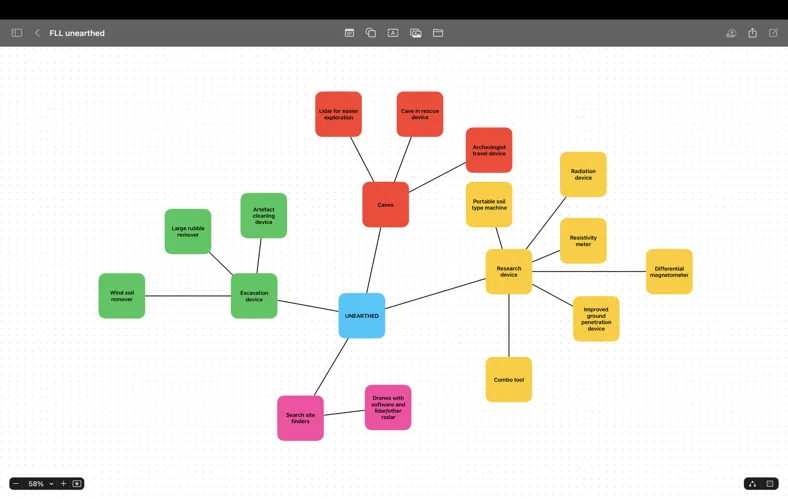
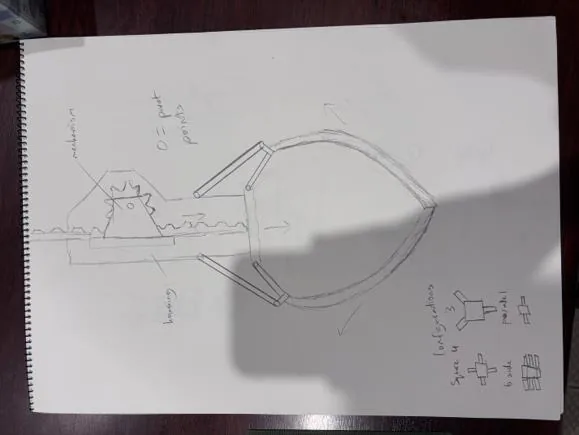
The innovations track moves from the first brainstorm to a settled direction by week 3, when we settled on the early idea of improving manipulator arms. By week 10 we had decided on the linear mechanism to control all the fingers because it would be the cheapest to assemble, and by week 11 we had completed the rack and pinion mechanism for the linear claw and 3D printed a prototype. In week 12 we decided on the finger configurations: four in a square, three in a standard shape, two in a standard shape, and six with three on each side.
The programming track works run by run. Run 3 and run 2 were both being coded by week 10, run 3 finished in week 11, and run 2 finished in week 12. In week 13 we gathered at someone's house and made final alterations to all run codes, making sure they all consistently work. Week 15 was mostly mission 2, which had recently been proving extremely difficult and finicky.
The mechanical track finished the run 3 mechanism in week 10, then lost it in week 12 and had to either find or rebuild it. After the regional competition, weeks 14 and 15 went into planning new mission routes to gain more points and designing new mechanisms for those runs.
Organisation
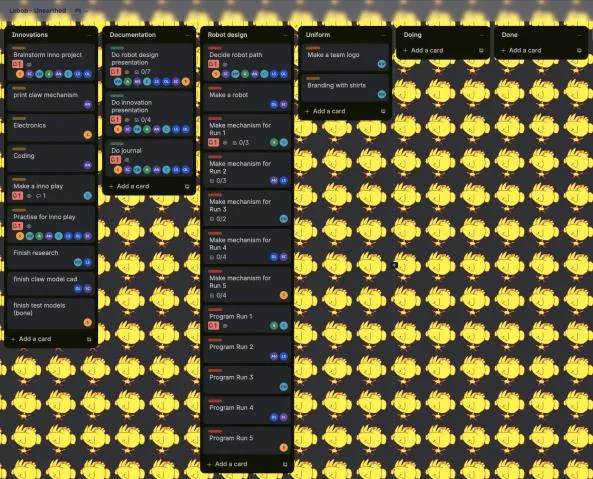
We used Trello for organisation and planning of what tasks needed to be done and when, and kept a shared board for the Unearthed season.
The run testing log
The bulk of this document is a timestamped log of every robot run we tested, starting on 1 December 2025, one day after regionals. Each entry records the time, the run number, what went wrong and what we changed.
The first day is a good illustration of the grain of it. Run 1 failed clearing the soil for the first time after building the mechanism, then did not go forward enough, then did not turn enough towards the soil twice, then turned too much towards the soil. The next attempt turned perfectly but sat too close to the soil, so the right arm went too far across it. The attempt after that turned perfectly but was too far away, so the right arm came down and did not touch.
That pattern, a small alignment correction logged run by run until the run is repeatable, runs for the length of the document. It is the progressive testing evidence we did not have the previous season.